

What is osteoporosis?


Osteoporosis is a progressive skeletal disease that leads to a decrease in bone density and results in alterations to its structure and therefore an increase in fragility.
What is osteoporosis?
It is an accelerated, progressive and diffuse decrease in the mineralization and density of the skeleton.
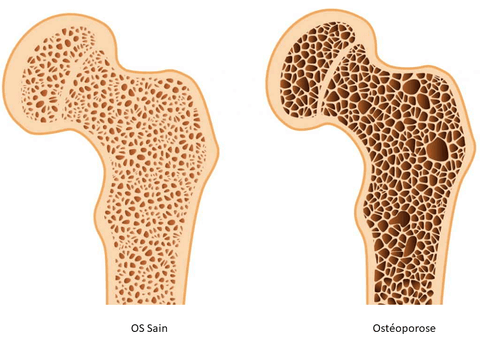
In practical terms, imagine that the very substance of the bone weakens, much like if the cement that holds the walls of a house together were to disappear. It's easy to imagine that the walls would become more fragile; the same is true for bones.
Loss of density reduces bone strength and makes them more susceptible to damage, fractures or cracks.
What are the different forms of osteoporosis?
The most common forms are the so-called primary forms. Primarily caused by age, they mostly affect women and less frequently men. This bone degeneration begins at the time of menopause.
With the onset of menopause, a deficiency in estrogen occurs, which normally inhibits bone tissue breakdown. This deficiency leads to increased bone loss and therefore progressive bone fragility.
There are other forms of primary osteoporosis whose origins are genetic and whose onset of development is significantly earlier.
Finally, there are forms which are secondary and which are the result of illnesses, treatments or poor lifestyle habits.
Among the causes are thyroid or parathyroid disorders, rheumatoid arthritis, kidney, liver, and intestinal diseases, cortisone treatments, and excessive alcohol and/or tobacco use.
What are the mechanisms responsible for osteoporosis?
Our bones, which make up the skeleton , are not an inactive and static mass; they constitute a living tissue with plasticity capabilities. Bone remodeling occurs through the action of two types of cells:
- Osteoblasts , which are used to create new bone.
- Osteoclasts which allow the destruction of old parts of the bone.
When bone destruction (resorption) takes precedence over bone formation, bone loss occurs. This begins around the age of 45.
Among the factors that disrupt this balance are:
- Vitamin D, an adequate intake of which is necessary to maintain normal bone metabolism
- Sex hormones, and more specifically estrogens, for the reasons mentioned above.
- Oxidative stress tends to increase the number of osteoclasts, leading to bone resorption.
- Metabolic syndrome (visceral obesity, insulin resistance, hypertension, high triglycerides, low HDL cholesterol)
- Insufficient intestinal intake or absorption of calcium, particularly during aging, can lead to impaired absorption.
How is osteoporosis diagnosed?
It is carried out by the doctor and is based on questioning the patient and on the analysis of bone density using a specific examination: osteodensitometry (which is based on the absorption of X-rays by bone mass. It is a type of radiography where bone density is quantified by measuring the amount of X-rays able to pass through the skeleton).
Bone densitometry allows us to determine bone mineral density (BMD) . It is expressed with a score that allows us to classify bone density:
- Score > -1: normal density
- -2.5 < Score < -1: osteopenia
- Score < 2.5: Severe osteoporosis
If the score is indicative of osteoporosis, the doctor uses a decision tree to choose the course of action and initiate or not a treatment.
In a future article , we will discuss the treatments and prevention of osteoporosis.
At Phytocea we have developed ReNacre , an innovative food supplement specifically for osteoporosis, combining vitamin D (D3 – cholecalciferol) and highly bioavailable calcium supplied in the form of mother-of-pearl powder, rich in aragonite, from the freshwater pearl oyster: Pinctada maxima .
=== content-split ===
7489814921430
=== content-split ===
